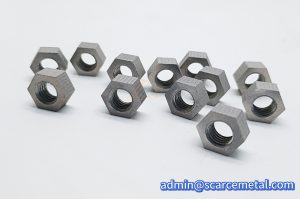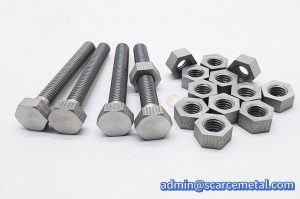
Tungsten Hexagonal Nut
Overview
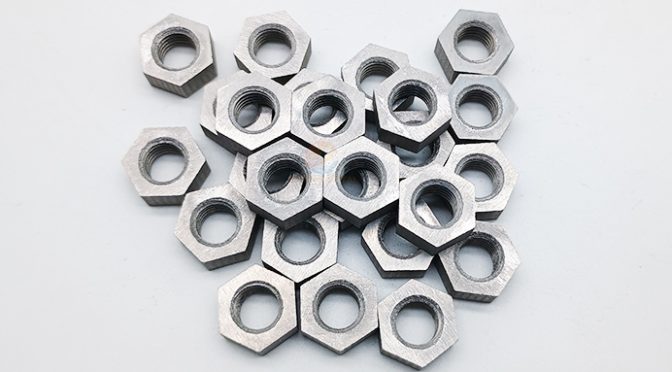
Tungsten Hexagonal Nuts are hexagonal fasteners made of high-purity tungsten or tungsten alloys (such as tungsten-nickel-iron and tungsten-nickel-copper). Their core advantages lie in their ultra-high density, high-temperature resistance (melting point up to 3400℃), and excellent corrosion resistance. Compared to ordinary steel nuts, they have a density approximately 2.5 times that of steel, providing significantly greater counterweight capacity in the same volume while maintaining structural stability in extreme temperatures and corrosive environments. Our company has over twenty years of experience in the custom production and export of tungsten, molybdenum, titanium alloys, and nickel alloys. If you are interested in our products, please feel free to contact us via email for a quote.
Properties
- Its ultra-high density provides significantly stronger counterweight capacity within the same volume, making it suitable for precision quality control applications.
- Its high-temperature resistance is exceptional; pure tungsten has a melting point as high as 3422℃, and tungsten alloy nuts maintain a tensile strength of over 800MPa even at 1300℃, far exceeding the failure temperature of ordinary alloy steel nuts (typically <600℃).
- Its low coefficient of thermal expansion ensures excellent dimensional stability under extreme temperature differences (-270℃ to +120℃), preventing loosening or cracking caused by thermal stress.
- Its chemical stability provides excellent resistance to acids, alkalis, salt spray, and radiation environments, resulting in a lifespan far exceeding that of stainless steel nuts, reducing maintenance costs.
- High hardness (Rockwell hardness ≥25°) and wear resistance ensure that thread fit accuracy remains virtually unchanged during long-term use, preventing accidental loosening under vibration.
Dimension
| Material | W1/WNiFe/WNiCu |
| Size | M2-M40 |
| Density | 17.5-19.3 g/cm³ |
| Coefficient of thermal expansion | 4-5×10⁻⁶/℃ |
| Tensile Strength | 800-1500 MPa |
| Standard | DIN933/ASTM/GB |
| MOQ | 1KG |
| Delivery time | 25-30DAYS |
| Certification | ISO 9001 |
Application
1. Aerospace
Tungsten Hexagonal Nut is widely used for connecting high-temperature components of aircraft engines, rockets, and spacecraft structures. With ultra-high temperature resistance and low thermal expansion characteristics, it is not easily deformed or loosened in high-temperature environments, stabilizing the overall structure and ensuring stable operation under extreme high-altitude conditions.
2. Automotive industry
Tungsten Nuts are suitable for fastening high-temperature, heavy-duty components such as automotive turbochargers, exhaust systems, and new energy motors. It has strong compression and vibration resistance, is not prone to slipping or loosening over long-term use, and can extend the service life of the power system.
3. High-temperature industrial furnace and kiln industry
Tungsten nuts and bolts are used for fixing internal components in industrial high-temperature electric furnaces, metallurgical sintering furnaces, and heat treatment equipment. They can withstand temperatures of thousands of degrees Celsius for long periods, do not oxidize or soften, stabilize furnace components, and reduce maintenance frequency.
4. Semiconductor precision equipment
M5 tungsten nut is used for semiconductor vacuum chambers, precision testing instruments, and high-end heat dissipation equipment assembly and connections. It offers excellent dimensional stability, allowing precise control of equipment assembly accuracy while assisting in efficient heat conduction and cooling.
5. Chemical anti-corrosion equipment
Used for flange fastening of chemical high-temperature conveying pipelines and reaction equipment. It has outstanding acid and alkali corrosion resistance, resists erosion of chemical media, avoids interface looseness and leakage, and ensures safe and stable chemical production.
6. Medical and industrial radiation
Mainly used to fix nuclear facility components and medical radiation protection equipment. Its high-density material effectively shields various radiations, and it is high-temperature and corrosion-resistant, realizing dual functions of equipment fastening and personal radiation safety protection.
Processing
(1) Using high-purity tungsten powder as the main material, adding alloying elements such as nickel, iron, and copper as needed (such as 90W-7Ni-3Fe), and ensuring uniform composition through ball milling blends.
(2) Cold isostatic pressing at a pressure of 150~220 MPa forms the bolt blank (retaining thread processing allowance).
(3) Sinter in a hydrogen/vacuum environment at 1700~2200°C to achieve granular metallurgy bonding, with a relative density above 99%.
(4) Rotary forging of sintered billets with 15%~20% radial deformation to simultaneously form threads and increase density.
(5) Deposition of hard coatings such as TiN and CrN (thickness 2~3μm) to improve wear and corrosion resistance, suitable for chemical environments.
(6) Conduct comprehensive quality control on finished products, including density testing, thread accuracy, strength testing, and non-destructive testing.
Pictures