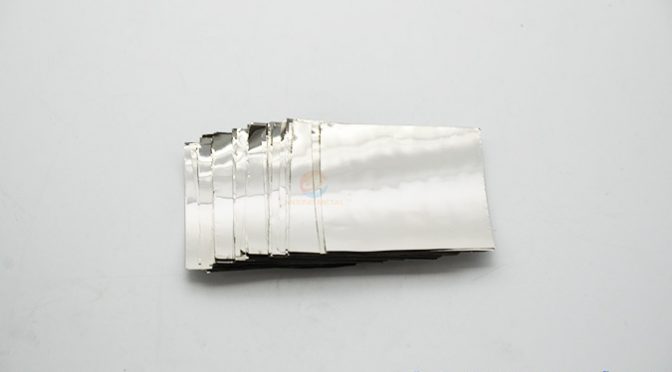
Bismuth Balls
Overview
Bismuth balls offer environmental friendliness, non-toxicity, high density, and excellent X-ray absorption properties. Their characteristic volume expansion during solidification renders them suitable for precision casting, mould manufacturing, and radiation shielding applications.
Our company supplies diverse non-ferrous metal products, including tungsten alloys, titanium alloys, nickel alloys, molybdenum copper, and platinum-iridium alloys. Through high-quality service support, exceptional customisation capabilities, and authoritative quality assurance, we have established collaborative relationships with numerous overseas nations. Should you require further information, please do not hesitate to contact us via email.
Bismuth Features
| vs lead balls |
① Non-toxic and environmentally friendly, posing no health or environmental risks; ② Exhibits reverse expansion during solidification, resulting in superior mouldability; ③ Superior corrosion resistance compared to lead (which is susceptible to corrosion by weak acids). |
| vs steel balls |
① Higher density, delivering superior weighting performance for equivalent volumes; ② Rust-free, with outstanding corrosion resistance; ③ Low thermal conductivity, ideal for thermal insulation applications. |
|
vs tungsten balls |
① Lower cost; ② Lower melting point, making it far easier to process than tungsten; ③ Superior plasticity, facilitating composite fabrication and welding. |
| vs copper balls |
① Significantly higher density than counterweights and shielding, with outstanding core advantages; ② Enhanced corrosion resistance, coupled with low thermal conductivity and low electrical conductivity, makes it suitable for specialised applications. |
Specification
| Material |
Bi |
| Purity |
≥99.99% |
| Density |
9.747g/cm³ |
|
Diameter |
0.3mm-50mm |
|
Thermal conductivity |
7.9 W/m·K |
| MOQ |
10g |
|
Delivery Time |
15-25 days |
| Standard |
ASTM/GB |
| Certification |
ISO 9001 |
Bismuth Balls Application
- Nuclear Industry and Radiation Shielding: Due to their high atomic number, Bismuth Balls offer excellent absorption of X-rays and gamma rays, making them suitable for use in protective equipment in medical devices and nuclear power plants. They also present a more environmentally friendly alternative to lead.
- Medical and Biomedical Applications: Employed in CT imaging, radiotherapy enhancement, targeted tumour drug delivery, and photothermal or photoacoustic therapy.
- Electronics Industry: High-purity bismuth balls are utilised in the manufacturing of low-melting-point alloys and lead-free solders for fuses, thermistors, and chip packaging, enabling rapid and stable sodium/lithium storage in battery anode materials.
- Chemical Processing and Catalysis: Functioning as catalysts or carriers, they participate in reactions for pharmaceutical intermediates, dyes, and polymerisation.
- Scientific Research and Experimentation: Employed in superconducting materials, quantum computing, and novel functional material research.
Processing
① Crush high-purity bismuth ingots, acid-wash them and weigh them.
② Melt the bismuth material, ensuring uniform composition through mechanical stirring.
③ Pour the refined bismuth liquid into preheated mould cavities, forcibly cooling it to form the shape.
④ Perform surface treatment via mechanical polishing to enhance surface finish.
⑤ Conduct purity testing, flow property testing and dimensional accuracy checks to ensure finished product quality.
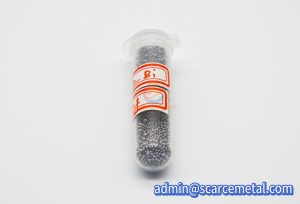
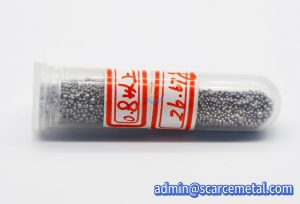
Bismuth Balls Pictures
Packing